

Who Is Our Customer?: Redefining Our Angi Homeowner
My Role
For this project, I worked closely with another Senior UX Researcher and a Lead UX Researcher given the size and scope of the project. I contributed to the design, execution, and synthesis of this large-scale quantitative research initiative. My responsibilities included shaping survey objectives, interpreting demographic and psychographic findings, identifying meaningful behavioral segments, and translating results into actionable insights for product, marketing, and strategy teams.
The Challenge
Angi serves a broad range of homeowners, but lacked a unified, data-backed understanding of who its core customers are, how they behave, and what motivates their decisions when maintaining and improving their homes. Without this clarity, teams risked designing experiences based on assumptions rather than evidence.
The challenge was to:
Define Angi’s homeowner customer using both demographic and psychographic data
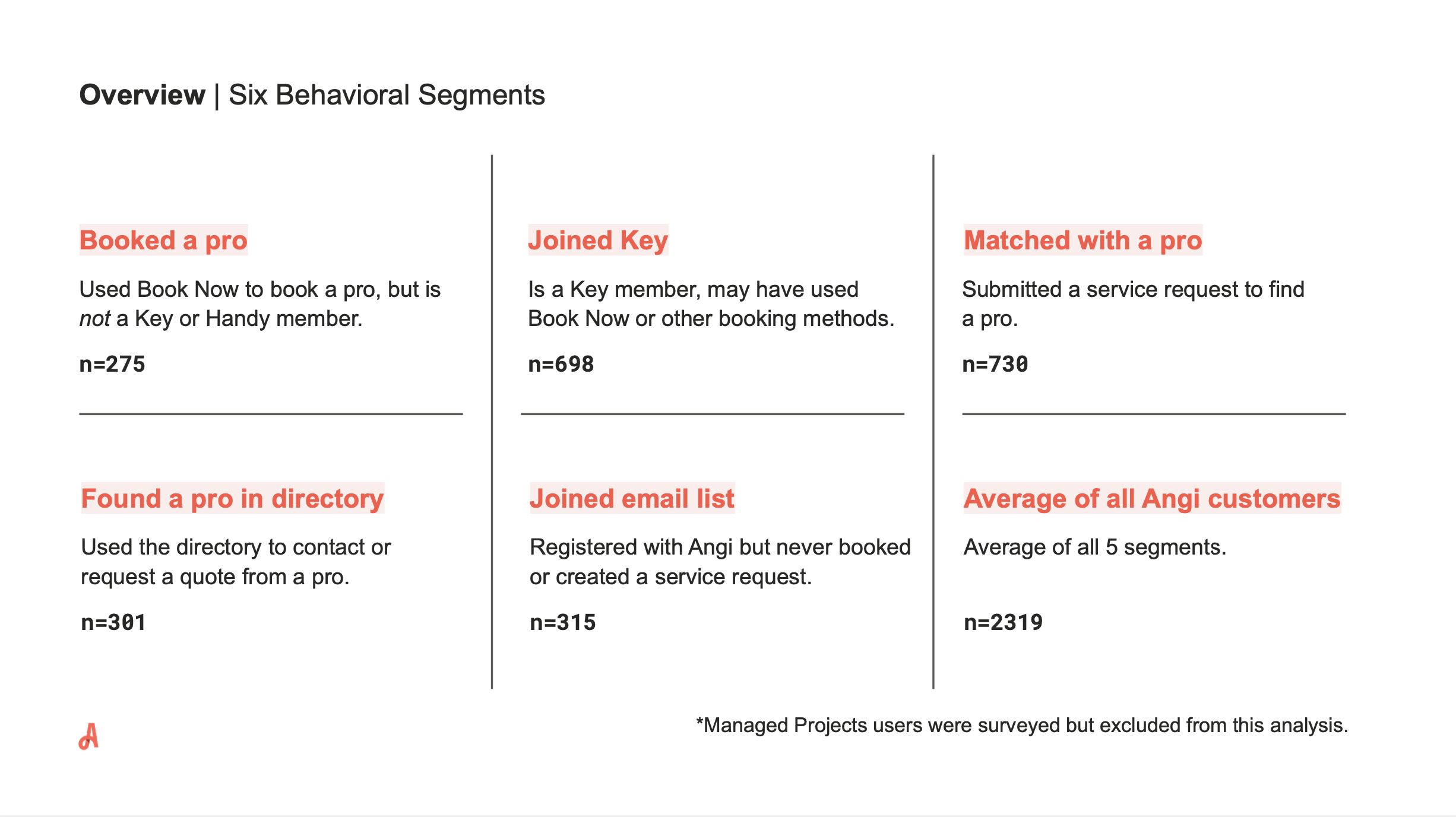
Identify differences across 5 key behavioral segments
Provide a shared foundation to inform product decisions, messaging, and prioritization
The Process
Research Approach
We conducted a large-scale survey of 2,392 current Angi customers across five behavioral segments, capturing both transactional and non-transactional users.
Methods
Quantitative survey with 41 demographic and psychographic questions
Behavioral segmentation based on how customers engaged with Angi (e.g., Book Now, Directory, Key, Email-only)
Comparative analysis across segments to surface meaningful distinctions
Analysis and Synthesis
Insights were organized into four core areas:
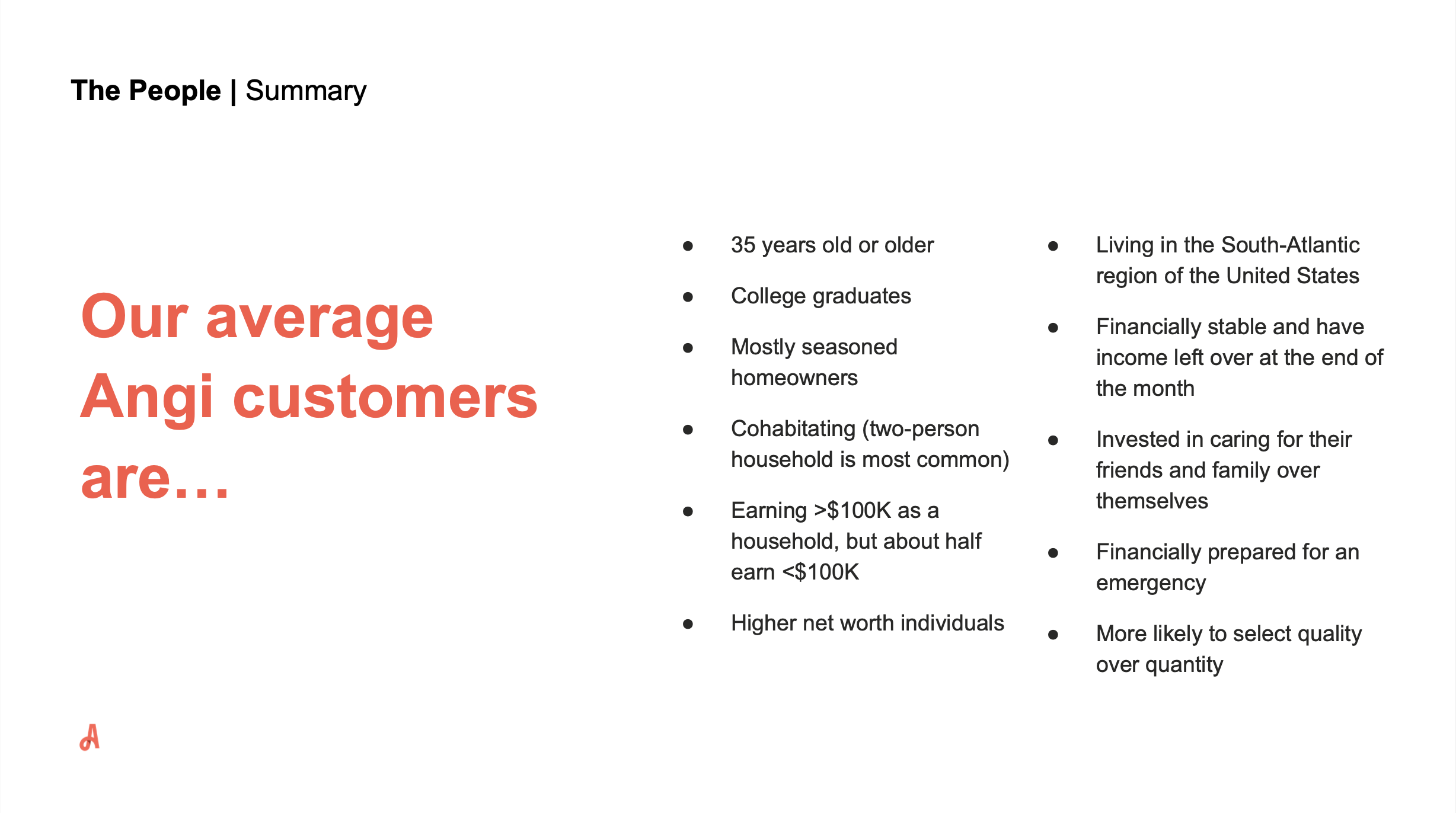
The People – demographics, education, income, net worth, and values
Their Homes – property type, age, household makeup, and location
What Happens at Home – media habits, brand sensitivity, and behaviors
Supporting Their Homes – how customers plan, hire, and pay for home services
This structure made the findings accessible and actionable for cross-functional partners.
Key Insights
Trust is the strongest lever for retention and repeat use.
Customers disengage quickly after poor service experiences, making trust signals—such as pro vetting, reviews, guarantees, and transparent expectations—essential UX components across discovery, booking, and post-service touchpoints.
Hiring behavior shifts based on project risk, not customer segment.
For low-risk tasks, users favor speed and simplicity; for high-stakes projects, they need comparison, validation, and control. Product experiences must support multiple hiring paths, allowing users to move fluidly between shortlist, directory, and deeper research without friction.
Financial readiness does not equate to decision confidence.
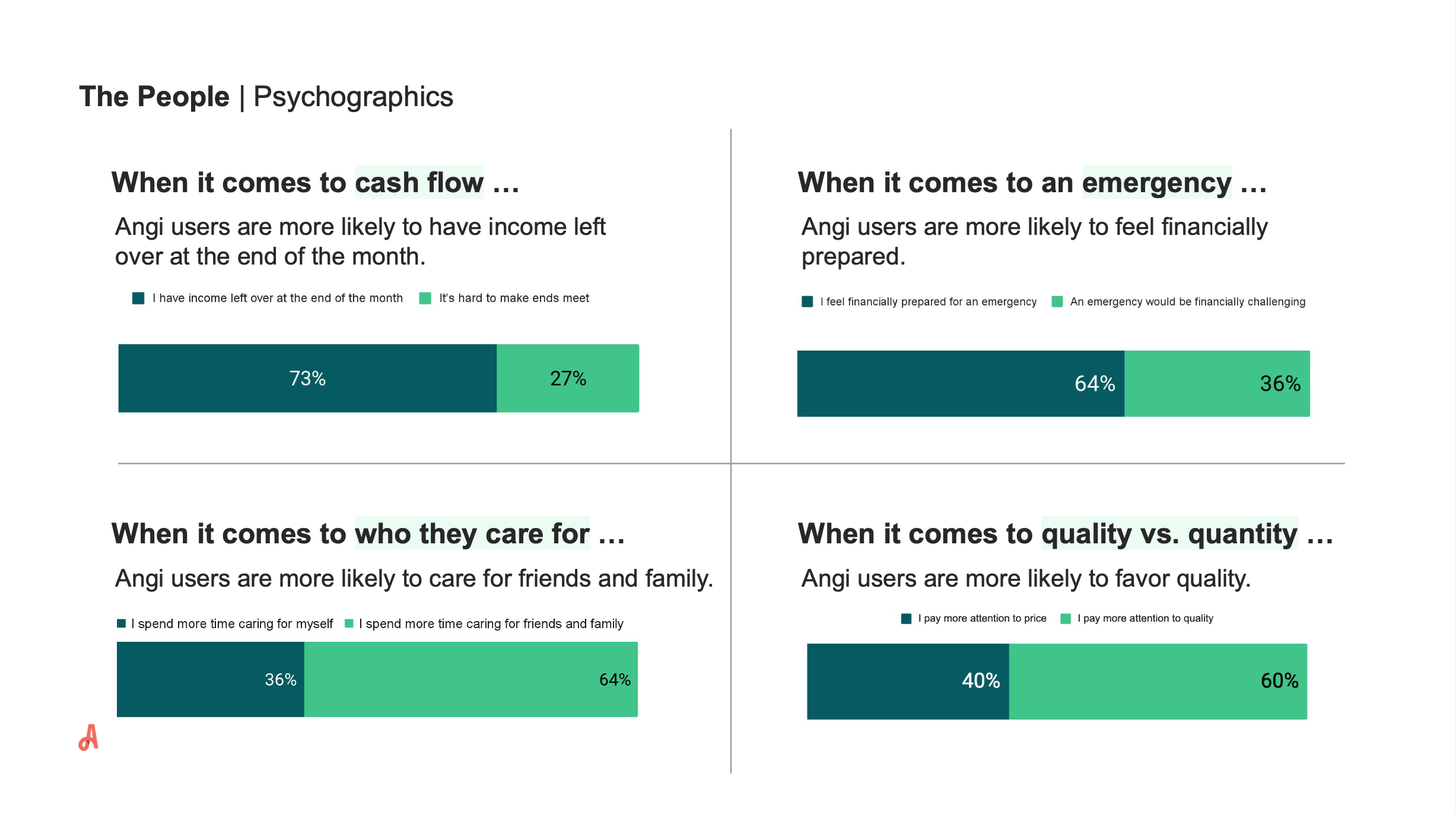
Even well-resourced homeowners experience anxiety around cost and outcomes, reinforcing the need for clearer pricing frameworks, scope definition, and proactive expectation-setting throughout the journey.
Device choice reflects intent and mindset.
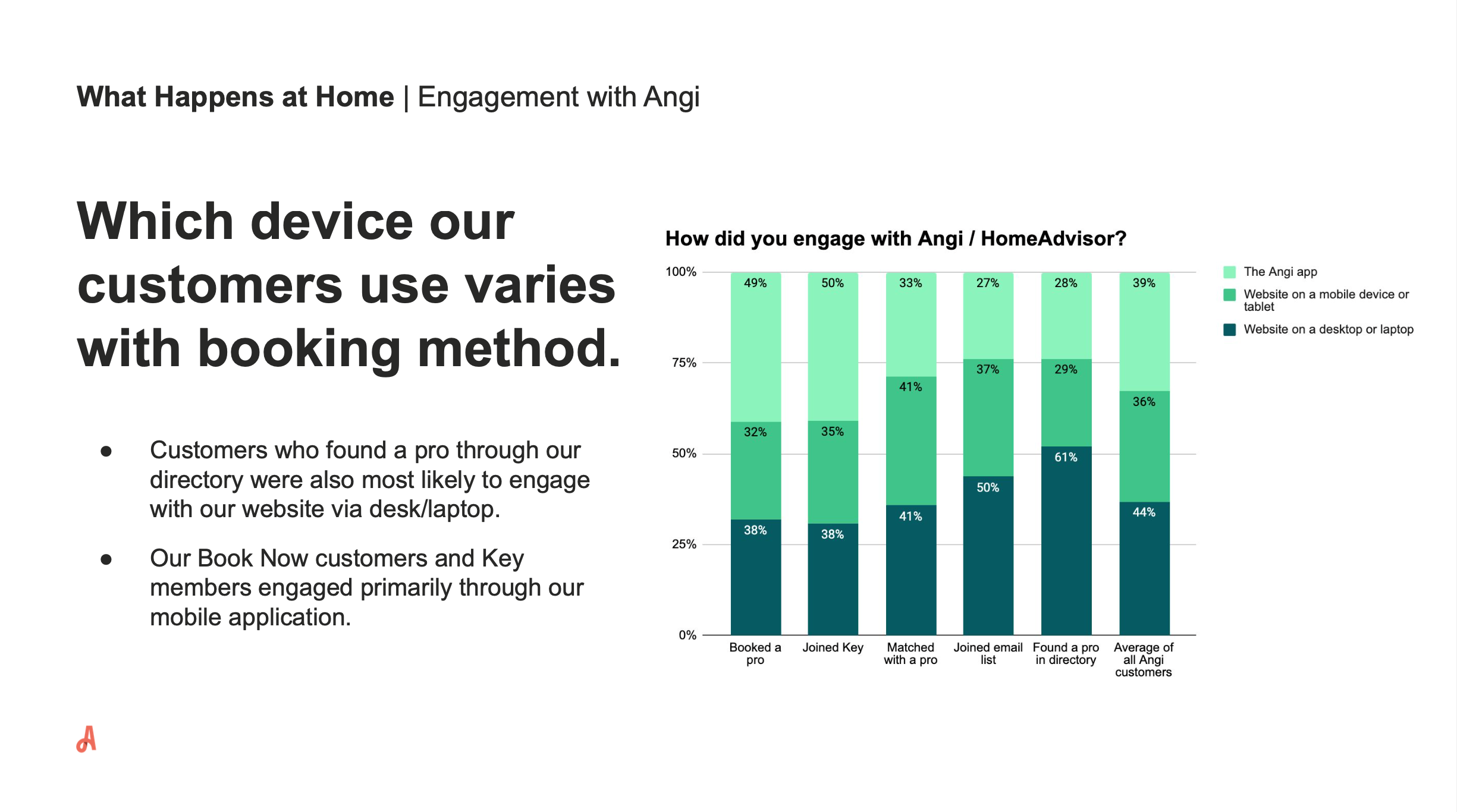
Mobile usage aligns with quick, action-oriented behaviors, while desktop supports research and evaluation. UX should intentionally differentiate these experiences—optimizing mobile for booking efficiency and desktop for comparison, education, and decision support.
Quality perception outweighs convenience for meaningful work.
When outcomes matter, customers prioritize confidence over speed. Surfacing craftsmanship indicators, past work examples, and accountability mechanisms helps users commit with confidence and reduces drop-off at critical decision points.
Conclusion
This research created a durable, data-backed understanding of Angi’s homeowner customer that directly influenced product strategy, experience design, and prioritization across teams. By clearly defining who Angi serves—and how needs, expectations, and hiring behaviors shift by context—the study enabled teams to design with greater precision, reduce reliance on assumptions, and align decisions around the customers most critical to Angi’s growth.
More importantly, the work elevated customer understanding from descriptive insights to actionable guidance, shaping how teams approached trust, hiring confidence, and experience flexibility across the platform. It established a shared foundation that continues to inform roadmap decisions and cross-functional alignment.
Reflections and Next Steps
This project reinforced that customer understanding is a leading indicator of business performance. Improvements in trust, clarity, and decision confidence are directly linked to higher conversion rates and stronger retention—particularly for high-consideration home projects where users are most likely to abandon the funnel.
If this work continued, the next step would be to operationalize these insights through measurable product experiments, such as testing trust and pricing clarity interventions against booking conversion, repeat hire rates, and churn. I would also recommend establishing ongoing customer segmentation tracking to monitor how shifts in experience design impact retention and lifetime value over time.